
A lot of people aren’t particularly keen on screaming in music. Thats fine, to each their own. Heavy music of all types is designed to be aesthetically challenging and sometimes a challenge just isn’t what you’re after! I’m not here to convince you to check out the latest Slayer record or swap Nickelback for Napalm Death – there are other places where people have argued the case for heavy music far more eloquently than I could.
No, I’m here in fact to illustrate the possibilities that can open up when you incorporate screaming into non-heavy music.
When most people think ‘screaming’ the sound that can easily come to mind is a wall of guttural noise front and centre of a band filled with pounding drums and massively distorted guitars. However, I’d like to encourage thinking about the use of screaming in a much more textural role.
Often in the process of recording a song, it makes sense to start with the band members playing the song as they would live – for example, a drummer, a bassist, two guitarists, and a vocalist. From there you might start adding extra elements that aren’t possible with the limited band members, perhaps keys, or extra backing vocalists, or maybe even a cheeky string section if you really want to push the boat out! These overdubs can, when done well, take the intended feel of a song and amplify it tenfold. Of course, when done poorly it can turn the whole track into a bloated mess, but that just emphasises the point that it’s important to choose overdubs with care.
Screaming can be used in much the same way as any other textural overdub. For example, it can provide an interesting addition to the backing vocal texture, sort of like a harmony without a definite pitch. Using naturally distorted vocals in this way can add movement to an otherwise static piece of harmony, thicken the vocals without making it sound muddy, and create an unusual timbre that can really help bring the artists creative vision to life.
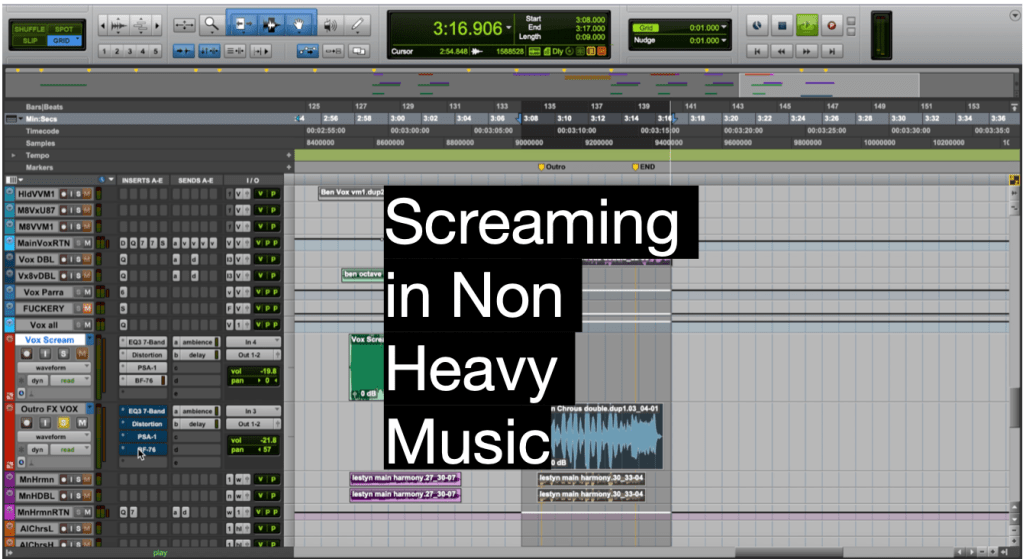
My band, The Kelly Line, have used screamed, or at least ‘naturally distorted’, vocals on a few of our tracks. In the video below you can hear how it was used in our recent single (Drum/Heart)Beat.
The chorus of this particular song involves long, sustained high notes. From the outset the intention was to create stacks of harmony around these notes, but for some reason it still wasn’t quite hitting the spot. Having experimented with different harmonies, moving vocal lines, and even instrumental overdubs, it still didn’t quite have the energy that we wanted. So I decided to try incorporating a scream along with the harmonies. Believe it or not there is an art to screaming, and as I am not particularly well practiced I found it easiest to focus on getting a scream with a good tone rather than one that perfectly fit the song. From there, I pitch shifted it into the key of the song, and added a little extra distortion to create the proper texture.
I also used another type of naturally distorted vocal during the outro of this track. Instead of aiming for a more guttural scream, as in the chorus, I instead essentially shouted the main melody as high as I could. As this type of screaming is less objectionable to a lot of music listeners it is possible to have them further forward in the mix, which helps to impart a sense of urgency and intensity to the vocal.
It should of course be pointed out that performing screaming vocals with poor technique can be dangerous, and you can risk seriously damaging your voice. If you’re curious about trying this arrangement technique be sure to do some research about how to perform safely, or better yet get someone who is experienced at screaming.
To listen to the track I’ve been refering to please click here – http://hyperurl.co/xivhst
 Ben Hughes Sound
Leave a comment