
Most of the time when I’m writing music, the chords are my starting point. With a chord progression alone you could almost build an entire piece of music – everything else is essentially just trimmings.
That may be something of an exaggeration, the point that chord progressions are important still stands, and they are a very good starting point when writing music. Even if you’ve already written a song (or you’re producing it), it’s always worth considering whether substituting a chord here or there could be the icing on the cake.
I often find that a simple way of adding a bit of colour is by making use of diminished chords. Because of their dissonant sound diminished chords are not often used in popular music, but when used correctly in a progression they can add plenty of interest without turning the song into some crazy experimental jazz piece.
In order to explain how I use diminished chords, it’s worth going over some basic music theory. (Feel free to skip this if you already know it!)
First you need to know the chords in a key. In a major key, the chords always follow the same pattern of major, minor, and diminished chords. It’s common practice to write the chords in a key using Roman numerals, with major chords written as capital letters and minor and diminished chords with lower case letters. The diagram below shows this pattern of chord types with the key of C major as an example.

In a key, different chords can be said to have different functions. For this particular technique you only really need to know two: Tonic function, and Dominant function.
Tonic function chords are chords that are at rest, that don’t pull the progression in any particular direction. The I chord of the key has tonic function, and it’s why most songs end on the I.
Dominant function chords are chords that strongly pull he progression towards the Tonic function chords. These chords create tension, and this tension is relieved when it changes to a Tonic function chord.
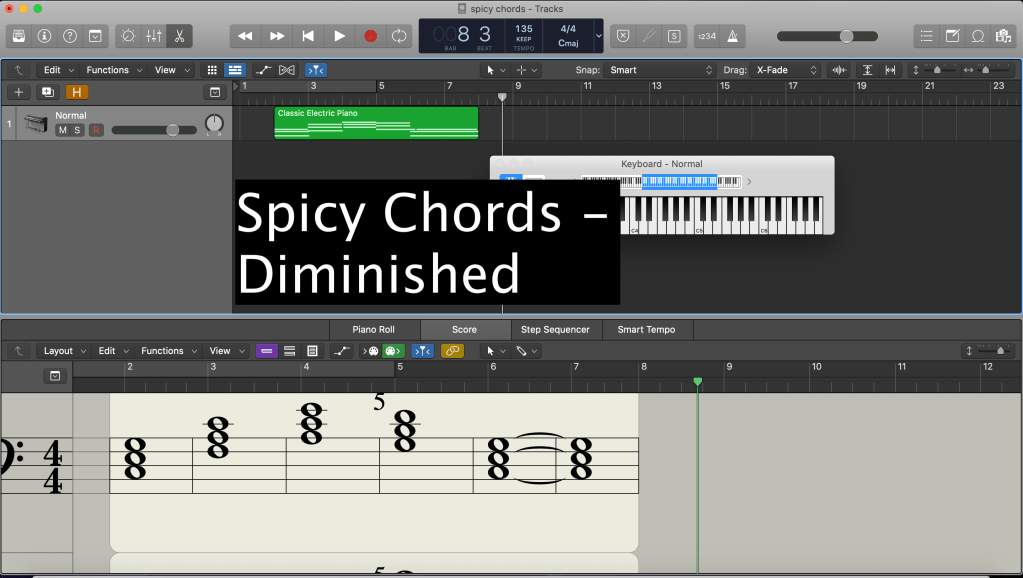
The most commonly used Dominant function chord is the V chord, and it’s (probably) the second most used chord in popular music after the one chord. But the vii chord also has dominant function, and in 90% of the situations you could use a V chord you could try out a spicy diminished vii chord.
So for example a chord progression could go:
I IV vi V I
And it would sound good, but it would also sound like half of the songs ever written. By swapping out the V chord for the vii chord you maintain the feel of the chord progression, but with the added benefit of using a fresh and unusual sounding chord you get:
I IV vi vii I
… obviously written down this doesn’t look very impressive, but by listening to the examples you hopefully get the gist!
Now I’m not saying that writers should never use V chords and that you should put vii chords absolutely everywhere you can, that would be crazy. But by simply trying the vii chord in place of the V chord you might find you can create fresh and exciting chord progressions that work in exactly the same way.
 Ben Hughes Sound
Leave a comment