
Who said acoustic guitar shouldn’t be distorted?
And I don’t mean as some strange and unusual effect to differentiate a punk song from the rest, or to satisfy the destructive experimentalist in us all. I mean plain old acoustic and vocals – the proverbial singer-songwriter with “a voice, an instrument, three chords and the truth” kinda vibe.
I recently had to record and mix just such a song. With only two elements to the mix there’s only so much you can do while maintaining that stripped back vibe. In fact it’s totally possible to argue that when recording a song like that the performance and the actual tracking is everything, and that you should mix as little as possible! However, I felt there were some tricks I could employ to help fully bring out the energy in the track.
Normally for a simple mix such as this my starting point would be equally simple. I almost always have three plugins setup on my master bus from the start – a Pultec EQ clone, an SSL master bus compressor barely doing anything, and a harmonic exciter of some sort. I find that starting a mix with these three elements already in place makes me less likely to drastically alter a mix with them at the end, while still giving me the option to tweak them later.
I’d then start by setting up a convolution reverb to simulate a realistic environment for the mix to inhabit, before EQing the various elements to bring out the presence in each while simultaneously cutting frequencies that clashed unnecessarily and lightly compressing to control the level of each element. In this case I found that In order to make the vocal sit effectively in the track I also had to use a touch of delay running into a shorter, less natural sounding reverb.
Once I’d done all this I was pretty happy with how everything was shaping up. The vocals and guitar both sounded distinct, yet natural and part of a cohesive whole. However, I was convinced there was something I could do to impart some real energy to the track without fundamentally altering the balance of the mix.
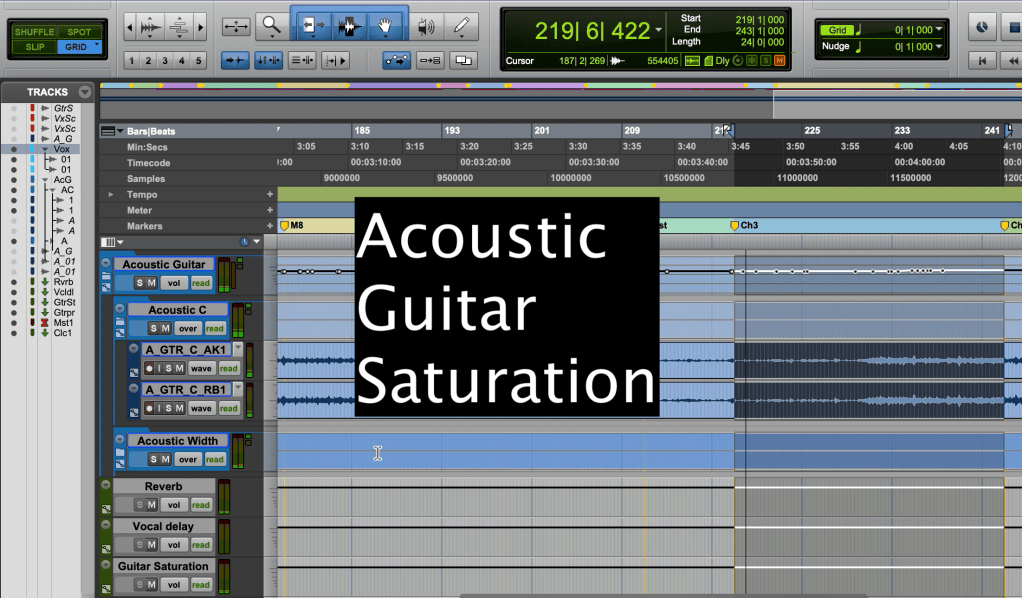
And that brings us to the topic of this post – distortion on acoustic guitar. More specifically, I’m talking about parallel distortion. Parallel processing is a pretty powerful tool, and it’s almost always something I reach for. In this case my thinking was that having a super saturated version of the guitar track would add thickness in the lower mid frequencies without adding any extra muddiness to the mix.
I tried a couple of different distortion plugins. One of my go-to ways of saturating a signal is by running it through an 1176 clone and compressing the life out of it. In this case it wasn’t appropriate as the sound of the compressor working was far too prominent. Next I reached for the Fabfilter Saturn, a multiband distortion plugin. This worked nicely by fiddling with some of the saturation presets, focussing mainly on the lower midrange. However, in the end I decided to go with the Soundtoys Decapitator. By using one of the electric guitar presets and fiddling with the drive I managed to get a sound that added thickness in the lower end, as well as a pleasing crispness to the higher frequencies.
By blending this parallel channel in I was able to affect the overall feel of the track without changing the guitar sound that I liked to begin with. In the end I also decided to use a separate parallel compression chain using the BF-76 to add a little more sustain to the guitar, as well as adding in a subtle extra colour. This worked in a much more naturalistic way than using the BF-76 on an extremely high compression setting, while still giving the desired affect.
When in solo this distortion channel might sound overly distorted, lacking dynamic range and low end. But when blended in tastefully, you can get all the benefits of using distortion without completely changing the original sound.
 Ben Hughes Sound
Leave a comment